TED Archives Mao Yu Lynn Yuan’s Speaker Info and Releases the TEDx HKU Official Video
- Mar 3
- 8 min read
Updated: Mar 4
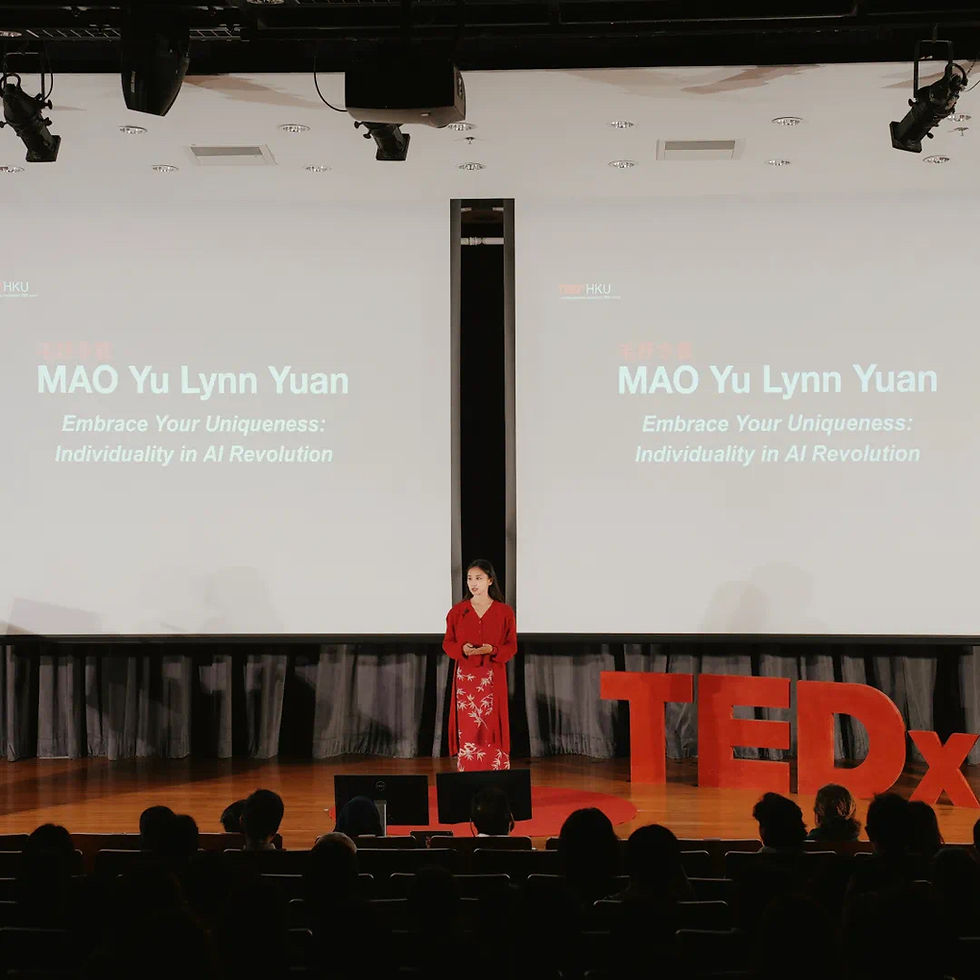
March 4, 2026 (Hong Kong, SAR, China) — The speaker’s introduction of Mao Yu Lynn Yuan at TEDxHKU has been officially listed on the TED official website (https://www.ted.com/tedx/events/60798). Her official TEDx speech video titled "Embrace Your Uniqueness: Individuality in the AI Revolution" has also been released simultaneously on the TEDx Talk official platform (https://youtu.be/exuCvgcgzUk?si=tn8ZjzXMXzAEmJLM), bringing this ideological sharing on the unique value of human beings in the AI era to a wider global audience.
The TEDxHKU event was held on February 15, 2025 at the Rayson Huang Theatre of the University of Hong Kong. According to the TED official website, Mao Yu Lynn Yuan is a China-born, Canada-raised practitioner active at the nexus of art, technology, and business. She holds roles as an award-winning film director, a United Nations SDGs gender equality advocate, a researcher in innovation-sustainability, and an entrepreneur. Her debut experimental art film pioneers AI-generated voiceover to amplify marginalized voices—particularly women’s.

In the speech, focusing on the era of the artificial intelligence revolution, Mao Yu Lynn Yuan explored the unique value and development of individuals under the tide of technology from multiple dimensions such as artistic creation, social development and business innovation, combined with her own practice. She analyzed the symbiotic relationship between artificial intelligence and human beings, emphasizing that in the era of rapid technological iteration, human emotional experience, independent thinking and innovative mindset are the irreplaceable core.
The inclusion of this speaker information on the TED official website and the launch of the official video on TEDx Talk provide an enlightening perspective for people in the AI era and enable relevant discussions to be further disseminated on the international ideological exchange platform.
Watch Mao Yu Lynn Yuan’s TEDx HKU Speech:
About TED
Organized independently by the University of Hong Kong, TEDx HKU is part of the global TEDx initiative. TED, a nonprofit founded in 1984, operates under the mission “Ideas Worth Spreading” and spans over 170 countries and regions. Its talks feature leading figures across disciplines, with a cumulative global view count exceeding 10 billion. Website: www.ted.com
Speech Transcript
Embrace Your Uniqueness: Individuality in the AI Revolution
MAO Yu Lynn Yuan
“Have you ever questioned the nature of your reality?” That was one of the opening lines in the science fiction series Westworld (2016), posed to Dolores, an AI-powered humanoid robot and the main female character who later developed human consciousness. So, I ask you, have you ever questioned the nature of your reality? This involves having human consciousness, understanding your identity, and asserting your self-authority to write your own life story, rather than allowing others to program it for you. Today, AI is evolving at a breakneck pace, becoming far more intelligent than we humans. When we reach the age of Artificial General Intelligence (AGI), which eliminates repetitive jobs, ushers in super individuals with flexible work routines, and grants us what we want the most, time, the uniqueness of our individuality, including creativity, empathy, and critical thinking, emerges as a new currency that differentiates us from artificial intelligence.

We are living in the era of the AI revolution. There are three types of AI: weak AI, strong AI, and super AI. Weak AI, also known as narrow AI (ANI), enables machines to outperform humans in specific tasks within limited contexts. Strong AI, or general AI (AGI), allows machines to exhibit greater intelligence than humans across a wide range of cognitive tasks. Super AI, or artificial super intelligence (ASI), is a hypothetical state where machines surpass human intelligence and show their own consciousness, much like the awakened robot Dolores in Westworld (2016).

Technically, we have transitioned from the age of weak AI to the era of strong AI, AGI. Machine intelligence is outpacing human intelligence, competing with human labor, replacing human jobs, and even influencing human values through AI algorithms. Every conversation, message, and digital footprint we leave on the internet serves as training data, which is processed through machine learning and then fed back to us. One day, my friend and I discussed about a thing. The next day, my shopping app started recommending it. I clicked “not interested.” However, the following day, another round of recommendations showed up, with better styles.

In this cycle, AI has become a part of our daily lives. Our information and opinions are significantly shaped by AI algorithms and revolutionary AI innovations like ChatGPT and DeepSeek. In the growing market of AI-powered robotics, we are hurtling towards a world of human-machine social systems. Simultaneously, AI technology brings great wealth in the hands of a few organizations with exclusive access to such high-tech resources, leaving resource-poor regions behind and causing widespread unemployment. To some extent, this could lead to an exacerbation of the wealth gap and gender disparities. If the AI revolution intensifies a world of change, inequality, competition, and unemployment, what we can hold onto is our uniqueness as humans who can think, feel, love, experience, reflect, and create with personal emotions, something AI cannot do at present.

That was me in the 90s. Like Dolores before her awakening, I once confined myself to a so-called perfect female mold: being obedient, pleasing, smart but not overly so, and meeting others' expectations rather than my own. I was once the “kids from other families” (a Chinese expression), or a trophy child expected to achieve success. Looking back, I realize that this little girl was fortunate to have a loving family and earn so many “bravos”, yet she seemed to live as perfectly programmed as an AI-powered robotic, Dolores. However, three life-changing moments enabled me to embrace my individuality and write my own life story.

During my teenage years, my family expected me to pursue a career as a diplomat. Instead, I chose arts and management and launched my own business in my third year of university. A path that diverged greatly from that of “kids from other families” who typically secured stable jobs after graduation at public listed companies, state-owned enterprises, or the government. A path that I embarked on a journey full of uncertainties, facing social biases against women in business. For over a decade, we once aimed to become the next billion-dollar unicorn company with an innovative business model but didn’t achieve that. Nevertheless, I have became a “unicorn” in my own life journey as the founder. I collaborated with thousands of creators and entrepreneurs from multiple cultural backgrounds. Our team resembled a mini United Nations with cultural diversity. I traveled to nearly a hundred cities worldwide andI witnessed hundreds of startup successes and failures, from the inspiring story of two co-founders who quit their elite banking jobs to build a social-impact business to the sad news of a would-be billion-dollar unicorn company going bankrupt during a recession. Regardless, the decision to start and grow a company as an independent individual was a meaningful moment in my life journey. When I chose my passion, my passion also chose me.

Another turning point came post-COVID. Before the pandemic, I grew up and spent most of my life in Toronto, Canada, my second homeland. Then, during COVID, I returned to my motherland, China. Social expectations on women loomed large. I saw how women at my age were expected to marry, have children, and, if necessary, give up their careers. To be a so-called “perfect” woman, like a trophy wife evolving from a trophy child, women are often typecast into stereotyped social roles within a patriarchal system, such as daughter, wife, mother, grandmother, and other objectified roles, at the expense of sacrificing their subjectivity and growing their true selves. This is not just an Eastern phenomenon; in the West, women face a similar form of subtle oppression, with the term “childless cat lady” used in Trump election to stigmatize women. And it's not just women; men are also pressured to pursue an ultimate life goal of so-called “success, success, and success” which can overshadow their individuality and prevent them from exploring their true life desires. To drive positive social change on such gender-disparities, I decided to become a female film director. My first film, which supported gender equality under the United Nations’ Sustainable Development Goals (SDGs), was created during this time. It was modestly recognized with nominations and awards for the creative use of AI voiceover as an artistic device to highlight the lack of voices, especially those of women. I hand selected six female AI voices from a Silicon Valley innovation, spanning the ages from 10 to 80 and representing multiple regions with distinct accents. I then edited these voices into a chaotic composition, mirroring the chaotic social expectations of women. From a broader perspective, the fact that even the chaotic female voiceover is AI-programmed adds another layer of irony in my film.

Some of you may be wondering, “What was your third life-turning point?” During my second master's degree at the University of Hong Kong, instead of choosing an EMBA under the weird common biased assumptions that businesswomen prioritize profits and study EMBA for networks, I chose to study sustainability leadership governance and founded an NGO organization to drive positive change at the intersection of innovation and sustainability. One of the organization's long-term plans is to develop a sustainable AI for good program. As AI can control what we perceive externally and shape our opinions through information, there is a demanding attention to an AI governance framework: Sustainable AI. This refers to the development of trustworthy AI technologies that prioritize our planet and people in a long-term sustainable manner.

For me, it has taken years of an inner growing journey to form independent views and make self-determined decisions in the chaos of information and opinions from others. There is no one-size-fits-all answer to how women should be, how men should live, or how one should make life decisions. In the AI revolution, many of us might get trapped in an information cocoon. The first layer of the information cocoon is made up of the people around us. This could include your family, friends, so called besties or bros, even professors, who pass on information and opinions to you from within their own information cocoons. Some could be greatly biased because of their own cognitions. And the second layer of the information cocoon is the information we get from the internet. Remember the app recommendations mentioned earlier? The apps we use every day may constantly feed you a certain set of information based on your reads, likes and clicks, preventing you from stepping outside to see a whole picture of the world. If we fail to use critical thinking to filter and process the information and opinions from people around us and the internet, then a third layer of narrow-mindedness information cocoon might form.

Amit Ray, a pioneer of the compassionate AI movement, once said, “The evolution of AI should always be guided by shared human values, the protection of human rights, and the survival of future generations.” With Sustainable AI, we use the framework to regulate AI technologies from environmental, social, and governance (ESG) perspectives. To ensure that the energy consumption of AI systems and electronic waste are minimized according to standards. To push for solutions to social disparities such as the wealth gap and gender inequality. And to deal with issues like data privacy and information cocoons caused by AI algorithms. For the governments, companies, NGO organizations, and communities, to build a better sustainable world with AI is not only for us today but also for future generations tomorrow. And for individuals caught up in the AI revolution, we shall awaken our human consciousness and value our creativity, empathy, and critical thinking in an approaching competitive human-machine social system. After all, in this ever-changing world filled with overwhelming information and intimidating technologies, the only constant you can rely on is your unique self who cannot be replaced. Embrace your uniqueness—by finding who you truly are, where you truly want to be, and the impact you want to make in your life journey with your creativity, empathy, and critical thinking.